Why Soft Sacred Slow
I was sitting in the chair for a routine eye exam — the kind you book because it's been a year and you're due, not because anything feels wrong — when the technician got quiet and asked if she could run one more test.
That's how I found out I was losing my peripheral vision. Not in a dramatic collapse. Not in a moment I saw coming. In a fluorescent-lit exam room, on an ordinary Tuesday, because a machine noticed something my own body hadn't told me yet.
Months of imaging later — MRIs, CT scans, more specialists than I can count — I had a name for it: idiopathic intracranial hypertension. Pressure building around my brain, pressing on the nerves behind my eyes. The kind of thing that's supposed to announce itself with headaches so bad you can't ignore them. Except I already live with chronic migraines, so the warning sign that was supposed to send me running for help just blended into a life that already hurt sometimes. By the time we caught it, the pressure had already done damage that couldn't be undone. The peripheral vision I lost is gone. It isn't coming back.
I had brain surgery this year. A stent, placed in a vein in my brain, so the fluid that had been building up for who knows how long could finally move the way it was supposed to. The surgery went well. Recovery was hard and, mercifully, quicker than I feared. I'm still monitored every three months — pressure checks, visual field tests, a scan to confirm the stent is still doing its job. I'll likely be watched for the rest of my life.
I'm telling you this not because I want Soft Sacred Slow to become a health blog. It won't be. But I can't tell you why I built this space without telling you this, because this is the year my body made an argument my mind had already started to believe.
Here's the truth underneath it: I didn't reject hustle culture in one clean, decisive moment. I wish I could tell you there was a single Sunday, a single sermon, a single line in a book that flipped a switch. There wasn't. It was slower than that — a creeping, uncomfortable realization over months and then years that the pace I was living, the pace everyone around me seemed to be living, wasn't actually working. Not for my faith. Not for my family. Not for the woman I actually am underneath all the doing.
And then my body made the argument for me, in a language I couldn't argue with. Even if I'd wanted to keep hustling — even if some part of me had still been tempted to prove my worth through output — I physically couldn't. My vision wouldn't let me. My recovery wouldn't let me. For the first time, the choice to slow down wasn't really a choice at all. It was just what was left.
I've come to believe that was mercy, not just misfortune. God didn't cause my illness to teach me a lesson — I don't believe He works that way. But He met me in it, and what I found there is something I don't think I would have slowed down enough to find any other way.
What Soft, Sacred, and Slow Actually Mean to Me
I didn't pick these three words because they sounded nice together. I picked them because each one is undoing something in me that hustle culture built.
Soft is what happens when I stop asking "why can't I just do it like everyone else" and start asking "what does my actual design need." My brain doesn't work like a lot of other brains — I'm AuDHD, multipassionate, wired to move between a dozen interests instead of specializing in one. For a long time I treated that like a flaw to manage. Soft is choosing curiosity over criticism instead. It's building a life, a home, a business around how I'm actually made, instead of forcing myself into a shape I was never going to hold.
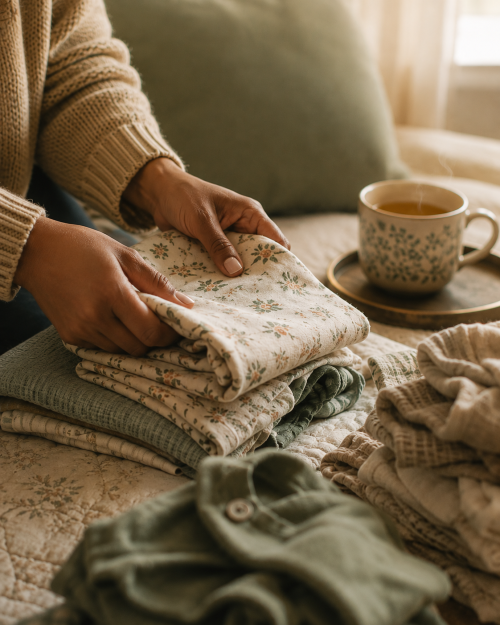
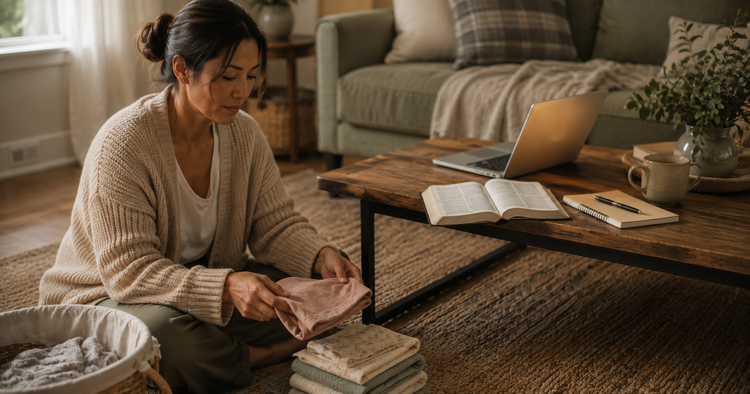
Sacred is the collapse of a wall I didn't realize I'd built — the one between "my faith" and "my actual life." I used to think ministry happened in certain rooms, at certain times, with certain language. Sacred is what let me see that folding laundry while praying under my breath is not a lesser version of worship than a Bible study. That the dishes, the school pickup line, the quiet moment with my coffee before anyone else is awake — all of it can be an offering, if I let it be. There's no secular half of my life I have to sneak God into. It was already His.
Slow is the one my body is teaching me now, whether I like it or not. It's the refusal to measure a day by how much I got done. It's building rhythms that can actually be sustained — not for one impressive month, but for years, through the hard seasons and the ordinary ones. Slow doesn't mean lazy. It means I've stopped pretending faster is always better, and I've started asking whether this pace, this specific rhythm, is one I could keep walking in five years from now. If the answer is no, it's not the pace for me — no matter how good it looks from the outside.
What This Means for My Life and This Space Now
These days, my life looks smaller than it used to on paper, and fuller than it's ever been underneath. I'm a wife and a homemaker first — that's not the thing I do around my "real" work, it is the real work, the first ministry I've been given. I'm mom to three boys in very different seasons: one inching toward the end of high school with college on the horizon, two younger ones still finding their footing in a new school. My husband is building his own career, and I get a front-row seat to that too.
Soft Sacred Slow lives in the margins of all of that — not because it's an afterthought, but because that's genuinely where my life is being lived. This isn't a brand I built and then tried to fit my life around. It's the other way. I'm writing down a life I was already living, because I spent a decade not writing any of it down, and I don't want to reach forty having lost another ten years of it to silence.
So here's what you can expect if you stay a while: I write about faith without needing it to look a certain way. I write about our home, our marriage, our boys, the meals I cook from scratch, the family history I go digging for, the books I'm reading, the goals I'm slowly learning to set without shame. It's not one thing, because I'm not one thing. It's all of it, held together by the same three words.
So, Will You Stay?
If any part of this — the slow unraveling of hustle, the body that stopped cooperating with a pace that was never sustainable anyway, the wall between sacred and ordinary finally coming down — if any of that sounds like something you've felt too, I'd love for you to stay.
You don't have to have it figured out to be here. You don't have to be further along in your faith, further along in healing, further along in anything. Come as you are, on whatever day you're having. That's the whole posture of this place.
I don't know exactly what all this space will become. I have a sense of the shape — the writing rhythm, the seasons, the slow build of an archive I actually kept this time — but I'm holding it with open hands, the way Sacred asks me to. What I do know is that I want to walk it out loud, in front of you, instead of behind closed doors the way I've done with so much of my life before now.
So — welcome. I'm really glad you're here.
If this resonated, I'd love to have you subscribe and become a member of my community — you'll get The Sunday Sabbath in your inbox every week, plus the ability to reply and share your own story right here on the blog. Come sit on the porch a little longer.
If this stirred something in you, I'd love to hear it — reply and tell me what this brought up for you, or share your own story below. This is a space to process together, not just read alone.
Comments ()