You Don't Need a Seminary Degree to Study the Bible: A Gentle Starting Place

I want to be honest with you about something before we go any further.
I have never fully outgrown the feeling of not being qualified enough to study Scripture. Even now, with years of reading and studying behind me, there are still mornings I open my Bible and feel that familiar flicker of who am I to think I can understand this? So if that's where you are, friend — if you've been circling the Word of God from a distance because it feels like something reserved for people with more training, more knowledge, more spiritual credentials than you — I want you to know you're in good company. And I want you to know that feeling is a liar.
The shift for me didn't come when I finally learned enough. It came when I stopped approaching Scripture like I was in a college class trying to get all the right answers, and started approaching it like I was sitting down with my Father, just wanting to be near Him.
That reframe changed everything.
Is the Bible Actually About Me, Or About Something Bigger?
Before I tell you how I approach Scripture, I want to share something that shaped everything else — because how you understand what the Bible actually is shapes how you show up to it.
The Bible is the story of God redeeming His people for His glory. From Genesis to Revelation, one thread runs through every book, every letter, every poem, every prophecy: God pursuing, restoring, and reconciling a broken world to Himself through Jesus Christ. It's the most sweeping, beautiful, costly love story ever told — and I'm in it, you're in it, but neither of us is the center of it. God is.
I had to sit with that for a while, honestly, because I'd been trained (like a lot of us have, without realizing it) to read everything through the lens of what does this mean for me. And while Scripture absolutely has profound, life-changing application for our daily lives, when I made that my starting question, I kept pulling verses out of context, applying promises that were never meant for me the way I was applying them, and ending up with a version of God that looked a lot like a cosmic customer service rep whose job was to meet my needs.
The Bible is for me. God intends for His Word to transform my life, renew my mind, speak into my circumstances. But it isn't about me. It's about Him. And when I keep God at the center — when my first question becomes what does this tell me about who God is? — I've found that everything else, including how it applies to my own life, falls into place with far more clarity.
Making Peace With More Questions Than Answers
One of the things I've had to make peace with on this journey — honestly, one I still return to — is that I'm not going to find all the answers this side of Heaven.
There are passages I've sat with for years that still hold mystery. Questions my Bible reading has raised that I can't resolve, commentaries that disagree with each other, theologians who've devoted their lives to a single book of Scripture and still hold their conclusions loosely. If the most learned biblical scholars in history have remained humble about the limits of their understanding, I figure I'm probably allowed to close my Bible some mornings with more questions than I started with.
And I've found — slowly, over time — that this isn't actually a problem. It's an invitation. Scripture isn't a puzzle to be solved. It's a living Word breathed out by a living God, and the process of returning to it day after day, year after year, with all my questions and confusion and half-formed understanding, is itself the point. As 2 Timothy 3:16–17 puts it:
"All Scripture is God-breathed and is useful for teaching, rebuking, correcting and training in righteousness, so that the servant of God may be thoroughly equipped for every good work." (BSB)
God-breathed. Not just historically significant, not merely ancient wisdom, but actively alive and useful — for teaching, rebuking, correcting, training. The Word is doing something in me every time I engage with it, even when I walk away confused. Even when I have more questions than answers. Even when I feel completely unqualified.
Psalm 119:105 calls God's Word a lamp to our feet and a light to our path. Not a floodlight that illuminates everything at once — a lamp. Enough light for the next step. I don't need to see the whole road. I just need to keep walking with the lamp.
What I Actually Do When I Open My Bible
A few years ago I got tired of feeling like I was doing Bible study wrong. I'd tried methods that felt like homework, approached passages like I was supposed to extract a certain number of insights in a certain amount of time, and consistently walked away feeling more like a student who'd failed a test than a daughter who'd spent time with her Father.
So I put together something that worked for my brain, my life, and the conviction I just shared with you — that God has to stay at the center. I ended up calling it the S.H.A.R.P. Bible Study Method, and I want to walk you through it the way I'd walk a friend through it, not like I'm handing you a syllabus.
I'll be honest — the acronym came first, the way these things usually do. But the name stuck for a deeper reason too. Hebrews 4:12 says:
"For the word of God is living and active. Sharper than any double-edged sword, it penetrates even to dividing soul and spirit, joints and marrow; it judges the thoughts and attitudes of the heart." (BSB)
Sharper than any double-edged sword. I love that Scripture doesn't describe itself as gentle background noise — it's living, active, cutting straight to the places we try to keep hidden even from ourselves. That's what I want this method to do, not as a technique for extracting information, but as a way of actually letting the Word reach the parts of me I don't always let anyone else near. Sharp isn't about being clever. It's about letting God's Word do what it already does best.
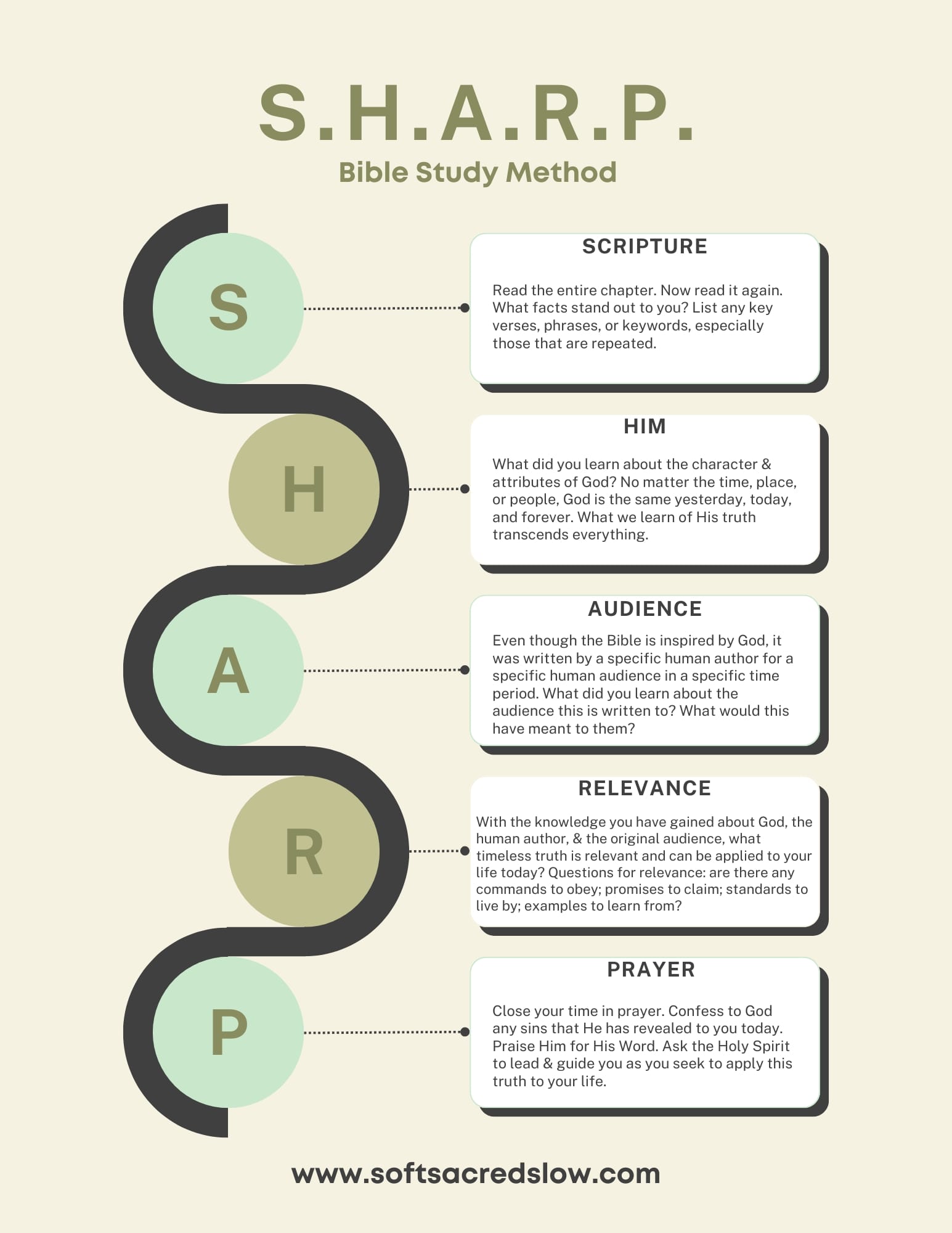
You can find it free in my shop. Print it out, save it to your phone, or just keep it open in another tab while you study.
I start with Scripture — just reading. The whole chapter, not only the verses I already know by heart. I read it once to meet it, then again to notice what stands out. No commentary yet, no cross-references. Just me and the text, paying attention. I need this step because I have a tendency to come to Scripture with my conclusions already formed, looking for confirmation instead of revelation. Slowing down here keeps me from skipping past what God might actually want to show me.
Then I ask about Him — before I ask what a passage means for my life, I ask what it reveals about God. His character, His attributes, His ways. This is the step that keeps everything else anchored, because God is the same yesterday, today, and forever — whatever a passage reveals about who He is stays just as true now as the day it was written.
Next I think about audience — who this was actually written to, and what it meant to them first. Scripture is God-breathed and timeless, but it was also written by a real human author, to a real human audience, in a real moment. This step protects me from misapplying things — a promise given to Israel in a specific covenant context means something different than a universal promise for all believers, and understanding that doesn't make Scripture less relevant to me. It makes my application of it far more honest.
Only then do I get to relevance — with everything I've learned about God, the author, and the original audience, I ask what timeless truth is here, and how it lands in my actual life today. Notice that's step four, not step one. I've done the work of understanding what the text actually says before I ask what it means for me, and that order matters more than almost anything else.
And I always close in prayer. I confess what God has revealed. I praise Him for His Word. I ask the Spirit to lead me as I try to live out what I've just received. I don't just walk away with information — I walk away having actually talked to the God who gave me the Word in the first place. This is the step that keeps the whole thing from becoming an intellectual exercise. The goal was never to know more about God. It was always to know Him more deeply.
You Don't Have to Have It All Figured Out to Begin
Here's what I want you to take away from this, more than any method or framework:
You're allowed to come to Scripture as a daughter, not a student. Bring your confusion, your questions, your half-formed understanding, your not-enough feeling — and just sit with your Father in His Word. He isn't grading your comprehension. He isn't keeping a record of the mornings you didn't understand. He's simply present, and His Word is alive, and every time you show up to it something is happening in you even when you can't feel it.
You don't need a seminary degree. You don't need the right study Bible or the right method or the right amount of time. You need a willing heart and a God who meets you in His Word — and friend, you already have both.
Start where you are. Come back tomorrow. Keep the lamp in your hand and take the next step.
That's enough. It has always been enough.
If this resonated, I'd love to have you subscribe and become a member of my community — you'll get The Sunday Sabbath in your inbox every week, plus the ability to reply and share your own story right here on the blog. Come sit on the porch a little longer.
If this stirred something in you, I'd love to hear it — reply and tell me what this brought up for you, or share your own story below. This is a space to process together, not just read alone.

Comments ()